
Handling high temperatures with Razor Sharp Measurements
INFOTherm designs hair-thin temperature sensors for demanding industrial environments. Fabry-Perot sensors promise 50 mK precision up to 800 °C.
Temperature measurements play a key role in ensuring product quality, optimizing processes and protecting human health. Optical measurement methods and systems provide new approaches to the measurements of non-electrical quantities that are often associated with challenging technological, biomedical, production, scientific, transport, environmental, security and other application fields and systems.
Lack of appropriate standards for optical sensors
Despite very intense research in the past, only a limited number of optical-fibre sensing technologies have made a successful transition into practical applications. This is a consequence of complex and mass production incompatible concepts that often result in poor cost-to-performance ratios of existing fibre-sensing technologies, which has also led the absence of appropriate standards for optical sensors, such as for example those available for RTD temperature sensors and thermocouples. However, the continual evolution of temperature measurement technologies contributes to improved accuracy, efficiency, and adaptability, making them indispensable tools in a variety of sensor systems.
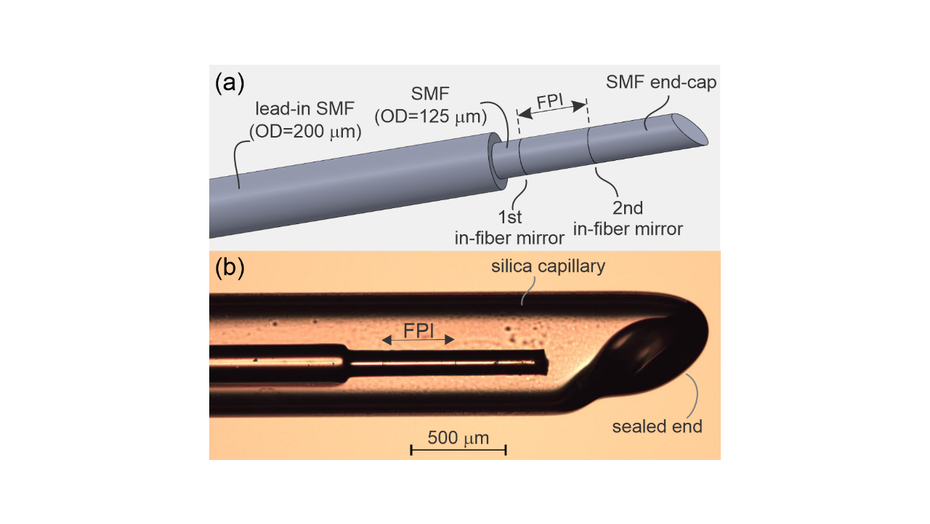
As measuring of high temperatures with high resolution in different harsh environments continues to present a major and broad challenge, research group from University of Maribor decided to look for a possible solution in the form of a Fabry-Perot (FP) temperature sensor. The sensor shown in Fig. (a) utilizes Fabry-Perot Interferometer (FPI) constructed between two semi-reflective mirrors, placed at the tip of a large 200 mm lead-in single mode optical fibre (SMF).
Sensor design and flexibility
Large lead-in fibre was extended with short section of standard 125 mm SMF, which ensures an airgap between the capillary wall and the sensor wall (Fig. (c), thereby ensuring no strain transfer to the sensor cavity in different packaging applications. FP temperature sensors offer flexibility in miniaturization and signal interrogation which is a major limitation in reducing the overall cost of optical sensor systems today.
Expected results and timeframe
The expected timeframe for finishing the project is end of August 2026, by when we commit to deliver results on Fabry Perot temperature sensors that are fully dielectric, miniature in size (sensor tip diameter slightly larger than human hair and shorter than 1 mm), can reliably operate in the temperature range up to 800 °C with a resolution at least of 50 mK.