
Need for the Project
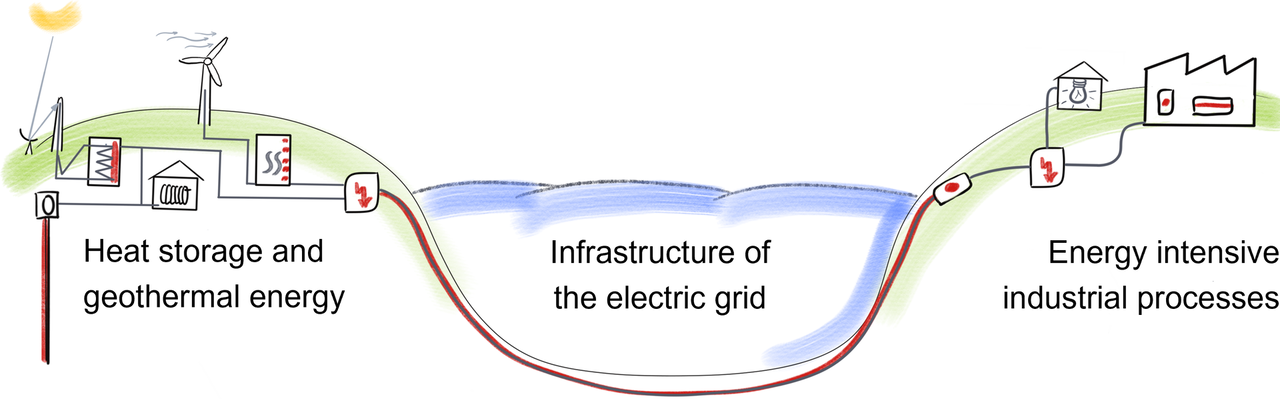
Transforming Europe’s energy system towards a higher share of renewable energy to meet the goals of the European Green Deal for a low-carbon energy system will require some infrastructure changes. For example, energy from wind and solar resources can be stored when production is high and released when less energy is produced. This can be achieved by thermal energy storage, such as tanks of molten salt at temperatures up to 560 °C, which require the measurement of the exact temperature and its distribution to quantify the loading state and to minimise losses through mixing. There is also a need to provide geothermal energy and seasonal storage of thermal energy in underground areas through multiple boreholes. Monitoring such boreholes can greatly improve system operation and integrity, but reliable temperature measurements with high spatial resolution are required along a path, not just at a few points.
Fluctuations in renewable energy production caused by local weather conditions increase the dynamics of the electrical grid and put additional stress on its components such as power cables and transformer stations. Monitoring temperature with instruments that are not affected by electromagnetic fields, such as fibre‑optic thermometers, allows better utilisation of existing infrastructure. In addition, some high-temperature processes (e.g. silicon production for solar cells or semiconductors) require precise temperature monitoring and control for efficient operation and product quality. Conventional high temperature thermometers (mostly thermocouples) have serious limitations due to ageing and drift. Stable contact thermometers for temperatures up to 1600 °C are urgently needed.
Existing commercial fibre‑optic systems are not traceable to the International System of Units (SI). Therefore, more work is needed to validate fibre‑based thermometry and make its use in key industrial applications more attractive. Most fibre‑optic thermometers have a Technology Readiness Level (TRL) between TRL4 and TRL7. However, for applications related to critical infrastructure monitoring and control, advanced manufacturing processes or quality control, this is not sufficient and independent verification, also known as TRL9, is required. TRL9 is provided by calibration services from accredited calibration laboratories, NMIs or an approved body under the Measuring Instruments Directive (MID).
Fibre‑optic thermometers allow temperatures to be measured in all the cases mentioned above, but they suffer from cross-sensitivities to other quantities (e.g., strain, vibration, humidity). In order to exploit the full potential of fibre-optic sensors (e.g. Fibre Bragg Gratings (FBGs) in silica or sapphire fibres) or distributed sensing techniques (using Rayleigh, Brillouin or Raman scattering), it is necessary to investigate, minimise and quantify these cross-sensitivities so that reliable results can be obtained. Standards, calibration guides and services are required to integrate fibre-based thermometry into the existing energy system and infrastructure.