
Progress beyond the state of the art and results
This project will go beyond the state of the art by developing new and validating existing methods to identify and quantify sources of measurement uncertainty of various point-like fibre-optic sensors (e.g. silica/sapphire FBG, Fabry-Pérot interferometer) and for distributed temperature sensing techniques (using Rayleigh, Brillouin or Raman scattering) used in the metrology community and industry sector. Based on these findings, calibration routines will be developed and validated for different temperature ranges and applications. The measurement uncertainty of at least three different fibre-optic temperature measurement techniques will be metrologically determined (partly for the first time) and improved. The aim is to achieve low extended target uncertainties (k=2) in expanded temperature ranges beyond the state of the art: 3 °C at up to 500 °C for distributed temperature sensing (DTS), 1 °C at up to 700 °C for FBG and 3 °C at up to 1600 °C for sapphire FBG. Finally, the sensors will be tested in industrial case studies relevant to the European energy system.

Objective 1: Quantifying the sources of measurement uncertainty.
Several institutes around the world have carried out studies on the reliability of temperature measurements using fibre-optic sensors, but no validated SI traceable calibration of these sensors has been carried out in Europe. This project will establish methods to investigate the specific effects for the different fibre-optic sensing methods and their influence on the temperature uncertainty. This will include the effects caused by thermal expansion, strain, vibration, ambient humidity and pressure, ageing effects and the influence of sensor mounting position. The aim is to fill existing knowledge gaps regarding the causes of measurement uncertainties and to increase the reliability of fibre-optic sensors, in order to establish calibration routines for fibre‑optic sensors.
Objective 2: Development and validation of DTS techniques.
Existing calibration infrastructure and methods are designed for the needs of point-like temperature sensors. In order to fully exploit the advantages of fully distributed sensing, novel validation and calibration approaches with respect to measurement uncertainty and spatial resolution will be developed. This will be used to determine the measurement uncertainty for a DTS method with an expanded target uncertainty (k=2) of 3 °C at up to 500 °C. An interlaboratory comparison will be performed to ensure the robustness of the validation. Furthermore, quasi-distributed point sensors (FBG) and distributed sensors (DTS) will be compared to determine performance differences.
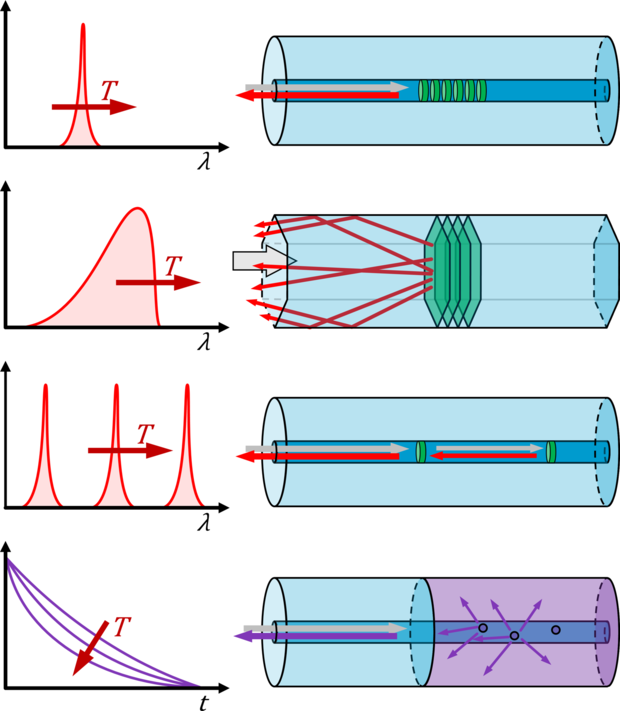
Objective 3: Development of fibre-based thermometry for harsh environments.
This project will develop, validate and calibrate silica and sapphire FBG‑based temperature sensing techniques for industrial conditions at high temperatures. FBG sensors in silica fibres will be developed and characterised to achieve an expanded target uncertainty (k=2) of 1 °C at up to 700 °C with traceable calibration. The promising results of EMPIR 17IND04 EMPRESS2 with sapphire-based FBG sensors will be improved to achieve an expanded target uncertainty of 3 °C at up to 1600 °C (compared to 10 °C at 1500 °C) and to meet industrial requirements. In addition, alternative approaches using modified sapphire FBGs with wavelengths around 800 nm, high-resolution Fabry-Pérot interferometers, and fluorescence-based fibre thermometers will be investigated to overcome the lack of metrological validation.
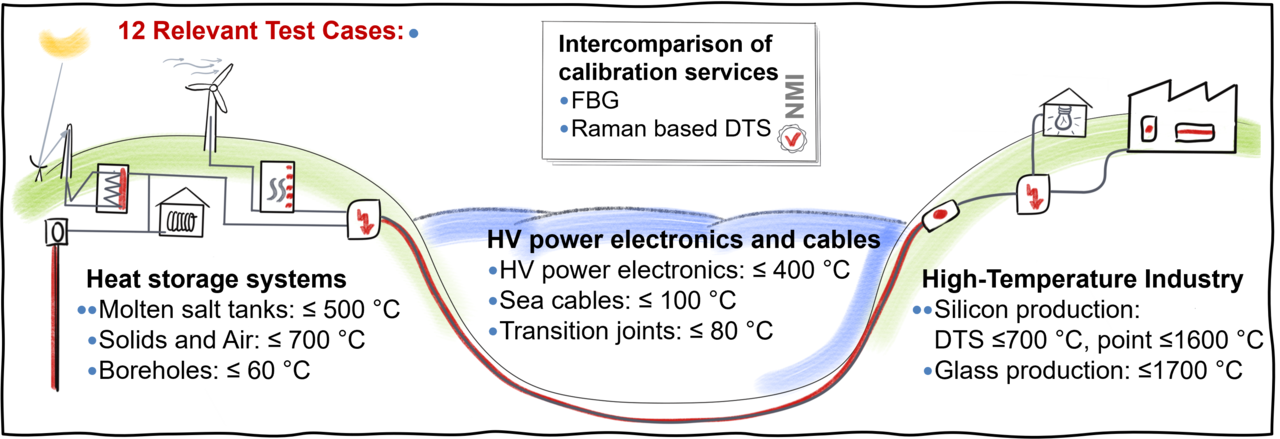
Objective 4: Case studies in key application areas within the project
The project will carry out 12 case studies in 5 key application areas for fibre optic thermometry to demonstrate the practical use of traceable fibre-optic sensors in a wide range of applications, each with its own specific requirements, including power cables and other parts of the electrical grid, energy‑intensive high‑temperature processes, heat storage tanks and geothermal heat storages, and NMI intercomparisons.
For the first time, the operational status of high-voltage components will be demonstrated using a calibrated fibre-optic sensor at operating voltages of up to 100 kV. Monitoring of high-voltage cables over many kilometres to improve electrical load management will also be carried out, and the defect analysis of transition joints will be investigated with unprecedented high spatial and temperature resolution (target 0.5 m and 0.1 °C).
Monitoring of energy-intensive high-temperature processes for glass and silicon production using sapphire FBG-based sensors at temperatures up to 1600 °C will be performed with improved accuracy, allowing advanced process optimisation.
The existing local electrical temperature sensors will be replaced by distributed and quasi-distributed temperature sensing solutions to monitor thermal storage systems, such as molten salt tanks. The fibre-optic sensors will cover a temperature range up to 500 °C and are expected to provide high-resolution temperature profiles needed to optimise storage efficiency.
The optimisation of seasonal geothermal heat storage with borehole depths up to 200 m using distributed temperature sensing will be investigated by studying the long-term stability of the sensors under operating conditions. In addition, methods will be developed to determine the effects of fibre ageing in existing borehole installations.
Finally, NMI intercomparisons between participants will be carried out to characterise the behaviour of sensors and readout units of different origins and to analyse systematic effects of the calibration infrastructure. This will provide the basis for future calibration services.